Operation Reboot Blog
Why I Wrote Operation Reboot
The idea for Operation Reboot began not with science fiction, but with family history. While exploring my ancestry, I discovered something unexpected. Like many Americans, I knew I had European forebears who arrived in the colonial era. What surprised me—delighted me, in fact—was evidence suggesting I might also have Mohawk ancestry.
The story was complicated. One ancestor, Abiathar Evans, was said to be the son of Samuel Evans and a Mohawk woman. That Samuel’s mother, Rebecca Kellog, had been abducted during the Deerfield raid of 1704 and raised among the Mohawks, while his father, John Evans, was half Abenaki and also raised in Mohawk country. John’s father, Jonathan Evans, had himself been taken in a raid and later formed a family with an Abenaki woman.
As I dug deeper, I learned that this Mohawk connection was probably not mine after all—Abiathar’s father was most likely another Samuel Evans, one without the Mohawk tie. Still, I was fascinated by the story of Rebecca Kellog, the Evans family, and the tangled relationships between Europeans and Native peoples in the early colonial period.
What I uncovered bore little resemblance to the simplified story I had been taught in grade school. “Colonization,” I came to realize, was just a polite word for invasion and conquest—driven by greed, expansion, and broken promises.
One book that deeply influenced me was Pekka Hämäläinen’s Indigenous Continent. It emphasized how conquest in North America unfolded differently than in Mexico or South America. The Spanish could topple the centralized Aztec and Inca empires by eliminating their leaders. North America, by contrast, was home to many smaller tribes, each independent, often competing with one another. This made conquest slower and more complicated—but eventually, it also made European domination inevitable.
The tribes themselves carried long histories of rivalry and warfare. The Wampanoag, for example, helped the Pilgrims in part because they hoped for allies against their enemies, the Narragansett. Among the Mohawk and others, “mourning wars” were a long-standing custom—raids to capture new members to replace those lost. The infamous raids on Deerfield, in which captives were taken and then raised as Mohawk, was rooted in this tradition. While such practices helped tribes survive demographic losses, they also fueled cycles of retaliation that hindered unity.
This history sparked a central question behind Operation Reboot: What if Native tribes had been able to set aside their rivalries and unite in the face of European invasion?
Even then, I doubt they could have fully resisted—the Europeans were simply too numerous and too technologically advanced. But it’s a powerful “what if.” In my story, Visitors arrive with knowledge to help level the playing field. Could things have unfolded differently? Could history have taken another path?
That question—the collision of real history, lost possibilities, and imagined futures—is what inspired me to write Operation Reboot.
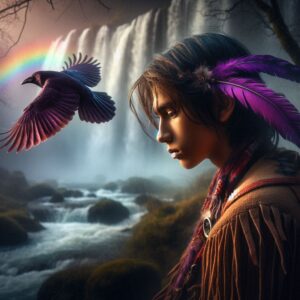
Join Little Feather on his quest!
I’m excited to announce that my new novel, Operation Reboot, will be released on September 12, 2025! This sci-fi time-travel, alternate history adventure asks bold questions about our past, our present, and the future of humanity.
In Operation Reboot, survivors from an apocalyptic future travel back to the year 1604, arriving in the homeland of the Mohawk Nation. Their mission: to help the Mohawk and neighboring tribes resist European colonization and rewrite history by creating a new timeline.
Original, deftly crafted, clever, riveting, and a simply fascinating blend of time travel science fiction, action/adventure, and a ‘what if’ alternative history theme, “Operation Reboot” is a fun and intriguing read from cover to cover. Author and storyteller James Hallenbeck demonstrates a genuine flair of the kind of narrative driven style that readers will find unique and compelling from start to finish.
“Operation Reboot” from Cold Mountain Publishing is especially and unreservedly recommended for community library Science Fiction collections and the personal reading lists of dedicated science fiction fans in general and ‘what if’ alternate history fans in particular.
Midwest Review
The story explores fascinating “what ifs”:
- What if the Indigenous peoples of the Americas had been able to resist European aggression?
- Could humanity have avoided the apocalypse?
- What might a world shaped by Indigenous culture and advanced technology look like?
At the heart of the story is Little Feather, a Mohawk youth who has endured the brutality of intertribal conflict since childhood. As the visitors share their advanced tools and ideas, Little Feather sees the possibility of a different path forward. But while some Mohawk leaders welcome the outsiders, others fear that their “gifts” may destroy their traditions and way of life.
Operation Reboot is a fast-paced, thought-provoking novel that blends time travel, Indigenous history, and speculative science fiction. Will the visitors’ technology empower the Mohawk to build a stronger society—or corrupt them and lead to an even darker future?
Available through Amazon, Barnes & Noble, and Kobo.

👉 Be sure to order your copy today and join the journey into an alternate history where the past—and the future—hang in the balance.
What Went Wrong? What Might Make It Right?
As humanity faces a growing list of existential threats—most of them of our own making—it feels urgent to ask: Where did we go wrong? And equally important: What would it take to set things right?
Operation Reboot is, at its heart, a meditation on those questions. Is there something in our nature—greed, arrogance, some “original sin”—that dooms us to fail? Or could different choices have led us toward a more sustainable, thriving society? If so, what foundations would those better choices have rested upon?
In grappling with these questions, I became acutely aware of why dystopias dominate our bookshelves and screens. Dystopian stories are easier to imagine, and their plots are simple: characters struggle to survive catastrophe and, perhaps, find a glimmer of hope. Utopias, by contrast, are rare and difficult. They demand not only vision but nuance—and, let’s face it, they’re not nearly as “exciting” as an apocalypse.
Operation Reboot isn’t utopian, nor is it strictly dystopian. At best, it’s a kind of “pre-utopia.” It wrestles with the flaws that have always haunted our species—our capacity for violence, greed, and division—while also exploring the strengths we share: cooperation, resilience, compassion. The question is not how to erase our weaknesses, but how to balance them, and how to build upon what is best in us.
To explore this, I chose a specific historical setting: the world of the pre-colonial Mohawk. Admittedly, I could have set the story in prehistory, even before Homo sapiens, and simply let my time-travelers’ struggles play out. But that would have stripped away the rich context of real historical choices. Instead, I wanted to revisit one of the great turning points of human history: the European invasion of the Americas.
European expansion reshaped the world, establishing a dominance that continues today. That dominance brought both achievements and atrocities, and the conquest of the Americas was among its darkest chapters. With superior technology—and the devastating impact of disease—Europeans quickly overwhelmed indigenous peoples.
Operation Reboot imagines a different balance of power. What if the Mohawk and their allies had been able to resist more effectively? What if they could draw on new knowledge, and in so doing force a reconsideration of what kind of society might emerge?
In making the Mohawk central to this story, I do so with humility and deep respect. I recognize I am an outsider, and I know I will inevitably fall short in capturing the depth of their culture. For any errors, I apologize sincerely; none were intended as disrespect.
At the same time, I wanted to avoid the all-too-common extremes in how indigenous peoples are portrayed: either romanticized as flawless or vilified as savage. The Mohawk, like all peoples, were complex—noble in many ways, but not perfect. Similarly, the Europeans in the novel serve as antagonists, yet the story is not a simple morality play of “Natives good, Europeans bad.” Instead, it’s a reminder that people everywhere share more similarities than differences.
If we are to survive as a species, it won’t be because one culture ‘triumphs’ over another. It will be because we recognize our common humanity and learn to borrow wisely from the best that each culture has to offer. That, ultimately, is the hope that lies behind Operation Reboot.
Martial Arts in Operation Reboot
Writers are often told to “write what you know.” While my understanding of Mohawk culture is limited, I’ve spent more than three decades studying Japanese martial arts—primarily Aikido, in which I hold the rank of third-degree black belt. That background strongly influenced how I approached the martial arts scenes between Tomoe and Spring Rain in Operation Reboot.
Of course, fight scenes on their own add a certain sizzle, but they can easily become repetitive and tedious. What interests me more—and what I tried to emphasize in the novel—are the principles beneath the techniques, and how training shapes character.
The famous swordsman Yagyū Jūbei once said:
“There are two paths to progress; one may enter through the path of principle, or one may enter through the path of technique. Principle and technique are firmly tied together. At the very heart of every technique lies a basic principle. Look beyond technique and discover the principle. That gives it life. Technique is the hammer that drives the principle into our consciousness. Without technique—the principle has no way to express itself—it is just an idea.”
That way of thinking—principle enlivened through practice—runs throughout Spring Rain’s training. Many of the exercises she endures are ones I experienced myself. I recall crossing swords with a master who needed no fancy moves or tricks to overwhelm me: he simply advanced, sword extended, and I found myself powerless to deflect him. Later, as I prepared for my third-degree black belt exam, I too experienced a moment of “awakening,” similar to that experienced by Spring Rain.
Spring Rain’s journey under Tomoe’s guidance also parallels another thread in Operation Reboot: Little Feather’s training with Julius. Their paths are very different—one focused on personal growth, the other on political awakening—but both require discipline, sacrifice, and resilience. By the end, the two characters recognize they are striving toward the same summit, even if they are climbing different sides of the mountain.
In that sense, martial arts in Operation Reboot are more than just a backdrop for action—they are a metaphor for transformation, discipline, and the pursuit of deeper truths.
A Bad Review
Yesterday I received a two-star review on Amazon. The reviewer was at least courteous enough to explain what didn’t work for him. Yes, my author’s ego took a small hit—but his points were thoughtful, and I think they’re worth addressing.
On “Dwelling on Minutiae”
The reviewer felt the book lingered too much on minor details. I’m not entirely sure which passages he meant, but I suspect he was referring to the technical sections—like how to make iron from scratch. In the grand sweep of the story, he’s absolutely right: these details are small.
But they’re small on purpose. I wanted readers to wrestle with how difficult it would be to rebuild technology from the ground up, even with the knowledge we already possess. Knowing how a gun works doesn’t help much if you’re living in a world that’s effectively back to the Stone Age.
On “Evil Europeans”
Another criticism was that the book paints Europeans as evil compared to the native peoples. I believe this misses the point. I’m careful to distinguish between people and the actions they take. Europeans, as I say in the book, are not inherently evil—yet they often engaged in actions that we can clearly recognize as such.
Likewise, while the Mohawk are the visible heroes of the story, they’re no strangers to violence, torture, or raids. My real subject here is evil itself: If most people are fundamentally decent, why do they still end up doing terrible things? That’s the question I want readers to sit with.
On Not Describing the Final Native Society
The reviewer was especially disappointed that I didn’t flesh out what the new society created by the Natives would ultimately look like. That’s a fair criticism. The truth is, I’m still exploring that myself, and the sequel will delve more deeply into it.
But again, I wasn’t trying to present a neatly packaged answer. I wanted readers to grapple with the underlying question: If our current system is built to self-destruct, what might a sustainable alternative look like? Before proposing solutions, it’s crucial to understand the foundational elements—both what to include and what to avoid.
In Operation Reboot, I start that conversation. Torture and slavery, for example, are clear societal toxins. While modern people might not engage in them outright, they often replicate the underlying power structures in more subtle forms—economic control being a prime example.
In the sequel, where the Mohawk pay a diplomatic visit to England shortly after the arrival of the Mayflower, I plan to explore land ownership as a mechanism of domination. Much of Europe’s aristocratic power grew from controlling land. To the Mohawk, the idea that an individual can “own” the land at all would be deeply puzzling. It’s likely that private landownership, in the form we know it, will not survive in their emerging society.
On the positive side, I argue that balance is essential to any stable civilization. Humans will always seek growth in some form—but growth must be tempered by social and ecological equilibrium. How to achieve that? That’s a question for the next book, and I welcome readers to ponder it themselves.
________________________________________
Bottom line: I’m sorry this reviewer didn’t enjoy the book—clearly it wasn’t his (or her) cup of tea. But I genuinely appreciate the feedback, and I’m grateful to the many readers for whom the story has resonated.