Physician
Author
James is a physician and associate professor emeritus at Stanford University in Palo Alto California. Prior to becoming a physician, he obtained a master’s degree in Asian Studies through the University of Hawaii with a focus on Japanese culture. He has published numerous articles on palliative medicine and geriatrics and is the author of two editions of Palliative Care Perspectives, published by Oxford University Press. The second edition was published in 2023. He is a recognized pioneer in the emerging field of palliative care and a champion for people struggling with chronic and terminal illness. His new book, The Chronic Illness Journey was published in the spring of 2025. Recognized for his ability to explain difficult medical concepts clearly, he is expanding his efforts to writing fiction. In the fall of 2025 he published his first novel, Operation Reboot.

Dr. James Hallenbeck



Operation Reboot
My debut novel, Operation Reboot takes place in pre-colonial North America. Time travelers, fleeing the impending collapse of civilization go back to upstate New York in 1604. They hope to aid the local Mohawks resist impending European aggression and thereby alter the timeline that led to the Fall.
Book Blurb:
THE FALL IS COMING. BUT HOPE LIES IN THE PAST.
As modern civilization crumbles under its own weight, a small band of travelers makes a fateful decision: go back. Back to the year 1604, to the land of the Mohawk. Armed with critical knowledge and carefully chosen technology, their mission is as daring as it is uncertain—empower Indigenous nations before European colonization takes root and offer a new path forward for humanity.
But history is no tame beast.
Little Feather, a disaffected Mohawk youth abducted in childhood, is drawn to the mysterious newcomers. Haunted by the brutal cycle of inter-tribal warfare and guided by visions of his spirit animal, he yearns to end the bloodshed that scars his people. The strangers may hold the key—but can he trust them? And will their presence change the future for the better, or unleash consequences even worse than the ones they hope to prevent?
Time is fragile. Destiny is not yet written. But rebellion runs edeep—in every age.
Midwest Book Review:
Original, deftly crafted, clever, riveting, and a simply fascinating blend of time travel science fiction, action/adventure, and a ‘what if’ alternative history theme, “Operation Reboot” is a fun and intriguing read from cover to cover. Author and storyteller James Hallenbeck demonstrates a genuine flair of the kind of narrative driven style that readers will find unique and compelling from start to finish.
“Operation Reboot” from Cold Mountain Publishing is especially and unreservedly recommended for community library Science Fiction collections and the personal reading lists of dedicated science fiction fans in general and ‘what if’ alternate history fans in particular.
FOR MORE ABOUT THE BOOK, CHECK-OUT OPERATION REBOOT BLOGS UNDER THE BLOG TAB ABOVE.
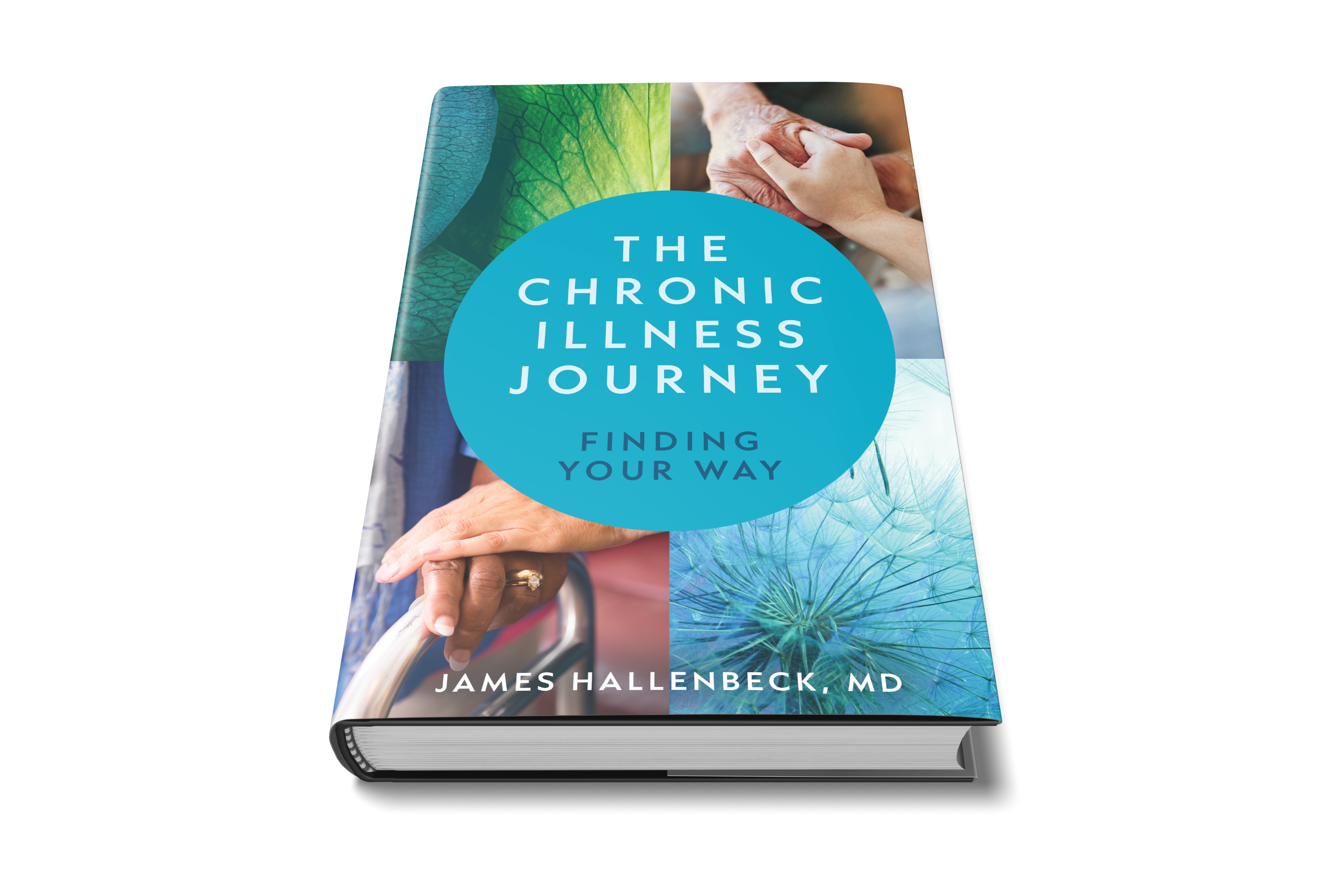

The Chronic Illness Journey – Finding Your Way
The Chronic Illness Journey is a book for people struggling with chronic illness, their families, and caregivers with a focus on common conditions of the elderly, such as heart disease, stroke, and dementia. The modern healthcare system is bewildering. In order to navigate it successfully, people need a plan. This book helps them put one together.
The author guides readers through common barriers they may encounter – knowledge deficits about common illnesses, communication challenges with professionals and family members, and nitty-gritty aspects of medical care – finances, insurance, and ‘tricks of the trade’ regarding care delivery. Finally, end-of-life care and related issues are discussed. Building on decades of clinical and administrative experience, Dr. Hallenbeck shares what he has learned along the way in hopes of helping folks on their journey.
This book should help people:
• Understand common illnesses of the elderly and more skillfully search out additional information about them.
• Establish and communicate goals of care
• Better communicate with clinicians and family members
• Avoid common pitfalls in different venues of care• Manage insurance and financing challenges
Chronic illness is tough on those afflicted and their loved ones. But with a little planning, the journey can be a bit easier.
FOR MORE ABOUT THE CHRONIC ILLNESS JOURNEY AND RELATED ISSUES, SEE THE CHRONIC ILLNESS JOURNEY BLOGS UNDER THE BLOGS TAB ABOVE.
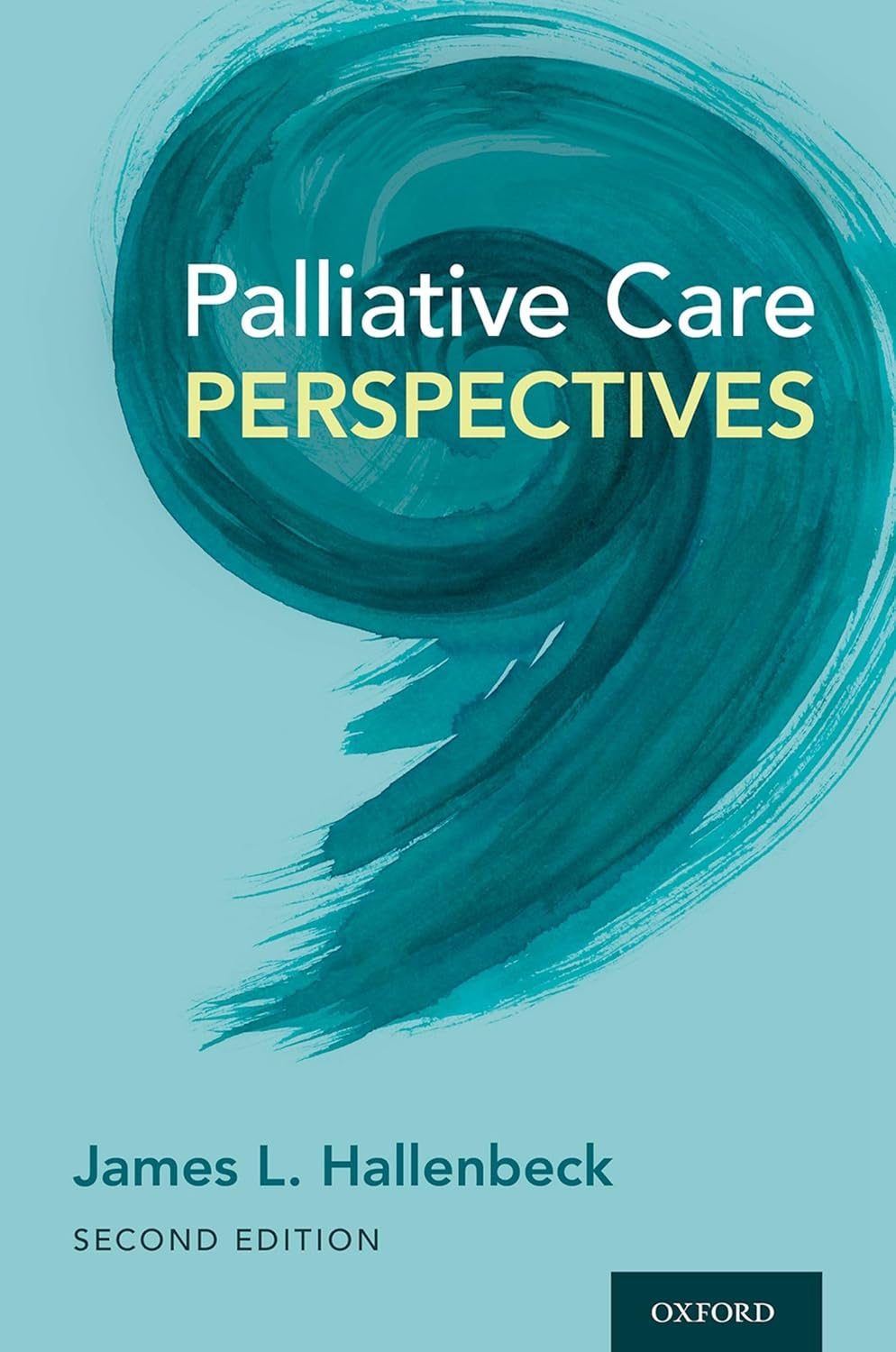

Dr. James Hallenbeck’s Medical Book
Palliative Care Perspectives
Palliative Care Perspectives is a guide to the art and science of palliative care that links real stories of illness with practical advice to delineate clinical practice in a way that reflects the daily concerns of clinicians.
Clearly and compassionately written, this book emphasizes important topics often neglected in formal clinical training, including the history and evolution of palliative care in the United States, as well as how clinicians can better understand aging and dying from both a physiological and human perspective.
Written by a recognized pioneer in the field of palliative care, each chapter highlights this human approach to illness with narratives and anecdotes drawn from decades of practice experience. This new edition features thoroughly updated research and citations, a new chapter on burnout and compassion fatigue, and a significant expansion of the topic of intercultural communication.
Well-grounded in the academic literature, Palliative Care Perspectives is an ideal introduction to the emerging field of palliative care for care providers new to practice, as well as lay readers seeking to learn more about chronic and terminal illness, presented in a personal and accessible format.
Reviews & Praise for Palliative Care Perspectives
Dr. Hallenbeck has put together an amazing resource for physicians just entering the field of palliative care as well as more experienced clinicians. The book combines abundantly well-referenced clinical information along with frequent pearls of wisdom based on Dr. Hallenbeck’s extensive career. I think Palliative Care Perspectives will become an essential book for both physicians and non-physicians caring for seriously ill and dying patients.
David E. Weissman, MD, FACP, Medical College of Wisconsin
Palliative care Perspectives has earned a place on my desk as a reliable reference and rich resource for clinical teaching… a concise and yet comprehensive guide to palliative care… the clarity and accessibility of writing and Dr. Hallenbeck’s wise and balanced approach to complex clinical problems makes reading Palliative Care Perspectives feel like I am consulting a learned and trusted colleague.
Ira Byock, MD, Author of Dying Well.
Modern medical practice need Hallenbeck’s book – comprehensive, scholarly, wise, and compassionate.
Joanne Lynn, Author of Handbook for Mortals.
5-Star Amazon Reviews for Palliative Care Perspectives
This is a compassionate, approachable discussion of the branch of medicine focused on treating dying patients, making them more comfortable as they near the end of life, rather than on trying to treat their illnesses in the hope of cure. It is written for medical professionals, but I am not a medical professional, and I found it very informative… Throughout the book, the focus is patients’ needs. The author’s approach is humane, open-minded, and oriented to effective results. Dr Hallenbeck clearly believes that listening is a key skill, and has as clearly listened carefully to his patients and learned a great deal from them That orientation has a lot to do with making this book a positive one to read, as well as a source of a great deal of useful information. From other reviews, it seems that medical professionals find it useful. So too did this non-professional – so much so that it will affect the choices I make when I am next responsible for the care of a dear one who is dying, and when my own time comes.
Anne Mills
This is a beautifully written summary of the essentials with lots of clinical vignettes and practical tips by an experienced and obviously dedicated clinician.
Vincent G. Winters
This book is spectacular. It covers all the major points in palliative care giving the reader very practical and useful information. The chapters on non-pain symptom management and communication are fabulous. I just can’t say enough good things about this book. It is an excellent overview for students, residents and even beginning palliative care fellows.
Dr. Pink
(For Palliative Care Perspectives, second edition.)
Excellent book. Covers a very complex subject in an easy to read way. Very valuable to both Health Care Professionals and also the general public.
Fernando Kawai
Awards
Pioneer in Palliative Care
California Hospice and Palliative Care Association
Pioneer in Palliative Care
Journal of Palliative Medicine
Pioneer in Palliative Care
American Academy of Hospice and Palliative Medicine
Henry J Kaiser Award for Outstanding and Innovative Contributions to Medicine Education
Stanford School of Medicine, Palo Alto, CA
Resources
Other Books
Palliative Care: A Resource Guide for Physician Education 4rd Ed.
Weissman DE, Ambuel B, Hallenbeck JL.
Medical College of Wisconsin. Madison. 2007.